When Does Adverse Weather Justify a Construction Project Delay? How Beacon Evaluates Weather-Related Delays Using Historical Data
By Marcus Lehner, Project Manager
Adverse weather can have a significant impact on construction schedules, particularly for weather-sensitive work such as roofing, site excavation work, and concrete pours. For this reason, contractors are typically expected to account for a “normal” amount of adverse weather when developing a project schedule. In some cases, construction contracts explicitly define an anticipated number of weather days that must be built into the schedule.
When a project experiences a particularly severe weather season, such as one with lots of extremely cold, snowy, or rainy days, it can become difficult for a contractor to obtain a time extension for lost days. This challenge often arises when the contractor is unable to clearly demonstrate how the experienced weather deviated from what would be considered normal or reasonably anticipated.
When reviewing a time extension request, or assisting a contractor in preparing one, Beacon relies on objective, historical weather data from the National Oceanic and Atmospheric Administration, or NOAA. NOAA maintains extensive historical weather records for locations across the United States. For example, data from Boston Logan International Airport includes daily records dating back to 1936.
Using this historical data, Beacon evaluates how many adverse weather days a contractor could have reasonably anticipated based on long-term averages and compares that benchmark to the actual weather conditions encountered during the project. This data-driven approach allows Beacon to provide objective support for weather-related delay claims or to identify when such claims may not be justified.
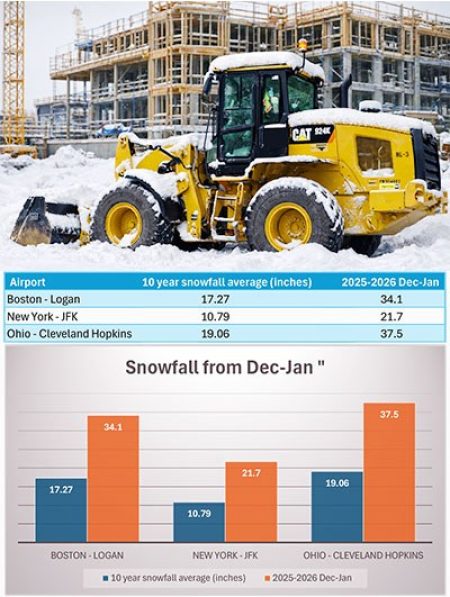
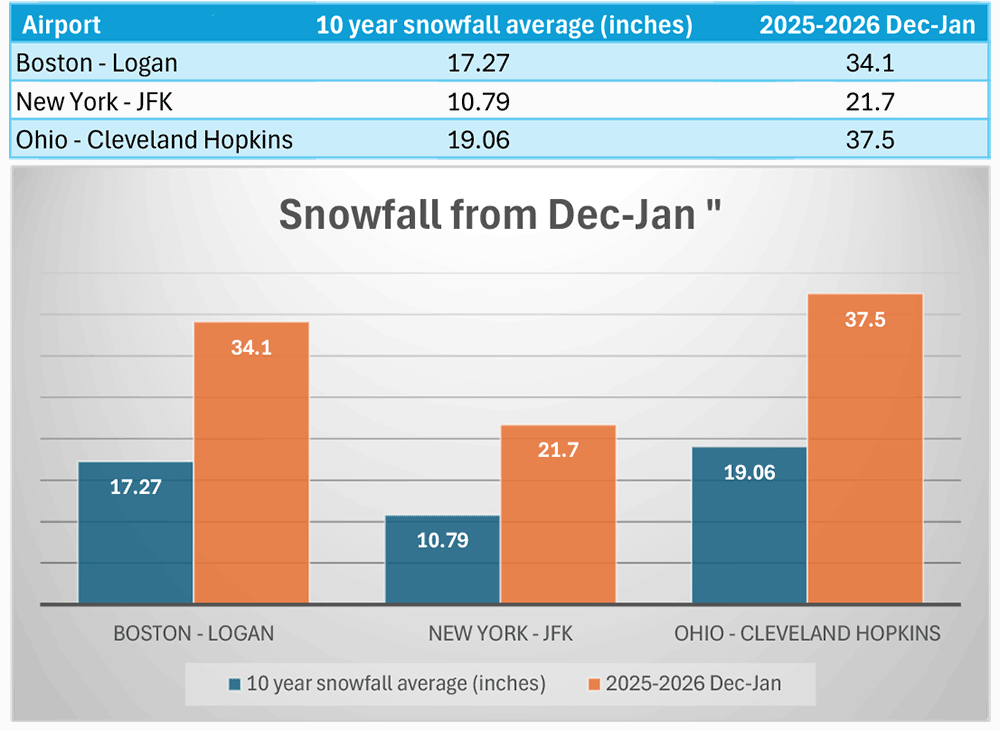
In the Northeast U.S., and across much of the country, we experienced several significant snowstorms in January 2026. The table below shows how recent, higher-than-normal snowfall levels at three separate locations have deviated from historical averages for the same time period. This table is an example of the type of historical data Beacon can produce and evaluate.
Contact Beacon if you need help reviewing or analyzing a possible weather-related project delay. Our team can access and analyze historical weather data to help determine whether time extensions are justified. In addition, we can develop a formal expert report to provide defensible support for your position.
*Click on the image below to see the full-size infographic.